




Written by

Olga Spackova
Engineering Manager

Marko Milosevic
Senior Data Scientist

Martin Ingram
Senior Data Scientist
Maintaining railway infrastructure is a complex task, requiring not only diligent monitoring but also the ability to interpret a wide array of data accurately. KONUX has developed a pioneering approach to enhance this effort – Population Correction Models. These models offer a powerful framework for interpreting sensor data from railway infrastructure. They enable us to fully leverage data from the many monitored assets by making our Industrial Internet of Things (IIoT) device readings comparable by correcting the data with known explanatory variables.
Why Correction is Needed?
Consider the following example: An acceleration RMS (Root Mean Square) of 4g might be perfectly normal for a crossing (frog) with a large angle (e.g., 1 in 5 or 1 in 9) under a train moving at 150 km/h. However, the same acceleration value is an alarming sign for a crossing with smaller crossing angle (e.g. 1 in 18) and a lower speed, such as 80 km/h. Without adjusting for these contextual differences, such discrepancies could go unnoticed or lead to false alarms. The possible number of combinations of these explanatory variables is so huge that a threshold-based approach to accounting for them (e.g. determining acceptable acceleration for different switch angles and different train speeds) becomes intractable and a model-driven approach is thus needed.
Population Correction Models are statistical models adjusting (in statistical terms correcting) raw sensor measurements based on known explanatory variables. These models establish baseline expectations for various infrastructure and measurement types under specific operating conditions (e.g., train speed, sleeper type, crossing angle). The result is a set of relative values – deviations from expected behaviour – which make it possible to reliably flag anomalies.
What Are Population Correction Models?
Population Correction Models are advanced statistical and machine learning models designed to normalise and compare signals from IIoT devices deployed across a wide variety of railway assets. The key challenge they address is the heterogeneity of railway infrastructure components in the field.
For example, Switches and Crossings (S&C) installations can differ by a range of explanatory variables:
- Design Attributes: These include crossing angle, sleeper material (e.g., timber vs. concrete) or rail type, all of which influence the sensor signals.
- Operational Usage: Assets are exposed to varying train speeds, axle loads, train types (freight vs. passenger), and traffic volumes, which all introduce signal variability.
Because of this, a raw device reading – such as an RMS acceleration – cannot be directly compared across different S&C. What might be a healthy signal for one type could indicate a potential issue for another.
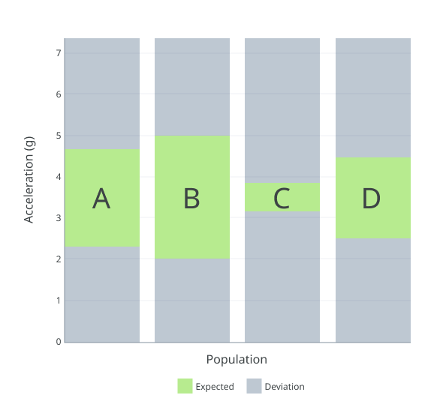
Relative metrics only make sense in context. Each population, defined by shared traits like load, speed or design, has its own expected normal range. The same value may be normal in one group and abnormal in another.
How the Models Work?
The models begin by learning average behaviours across a well-populated set of similar asset configurations. For example for S&C, they account for known influences such as:
- Train speed
- Train type
- Crossing angle
- Sleeper type
- Temperature
These average values become the “population baseline” for each combination of explanatory variables. Then, individual S&C are evaluated based on how their sensor readings compare to the population baseline. A deviation of, say, 250% above the predicted acceleration for a given speed and S&C type may indicate excessive wear or potential failure – long before a human inspector might notice it.
Transfer Learning plays a critical role, especially when dealing with underrepresented asset types (e.g., timber sleepers with rare configurations). Using transfer learning we can leverage patterns learned from well-populated groups (like concrete sleeper switches) and adapt them using domain knowledge and statistical adjustments. This cross-asset learning ensures that even sparsely populated configurations receive accurate benchmarks.
An example of population baseline RMS for different speeds and crossing angles for concrete sleeper assets at 12 °C temperature is shown in the following figure. This figure illustrates the average RMS acceleration values at railway crossings as a function of train speed and crossing angle, based on the KONUX Population Correction Model. The model reveals a clear trend: acceleration increases with both higher speed and larger crossing angles, as is also expected based on knowledge of railway dynamics.
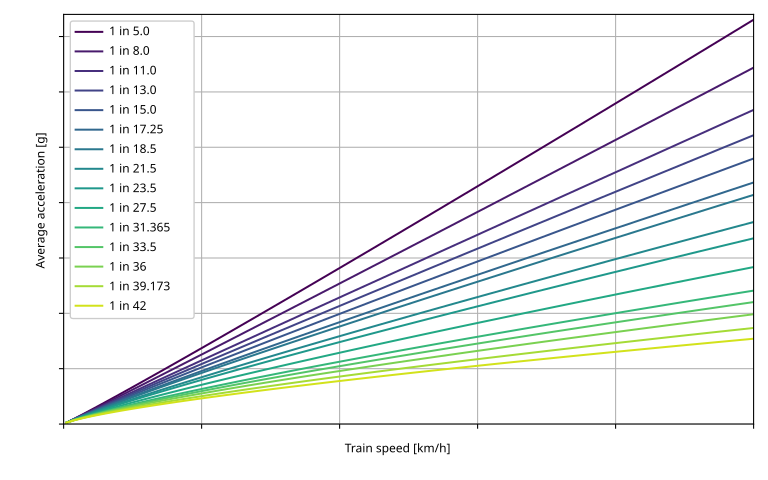
Average acceleration RMS – “population baseline” – at crossings for different crossing angles and train speeds as determined by the Population Correction Model. As expected, the acceleration RMS increases with speed and with increasing crossing angle.
Key Benefits for Railway Infrastructure
- Leveraging Big Data from IIoT Devices: With thousands of sensors installed across the network, railway infrastructure generates massive volumes of data. The interpretation of these data for maintenance decisions is however not straightforward due to the diversity of assets and their diverse operational usage. Population correction models make it possible to extract actionable insights by standardising signals across diverse assets and operational conditions.
- Enhanced Accuracy: By correcting for asset- and usage-specific explanatory variables, these models ensure that sensor readings are interpreted in the right context. This leads to more reliable assessments of asset condition, reducing both false positives and missed detections.
- Proactive/Predictive Maintenance: Early deviations from expected values can be flagged before any visible degradation occurs. This enables predictive maintenance, helping to extend asset lifetime and prevent costly failures
- Optimised Resource Allocation: By identifying which assets truly need attention, infrastructure managers can focus their maintenance efforts where they are most needed.
Conclusion
KONUX’s population correction models provide reliable and consistent insights across diverse railway infrastructure assets. By normalising data across varying configurations and usage conditions, they unlock the full potential of IIoT-based monitoring.
Looking ahead, continued advancements in machine learning and improved quality and availability of data feeding into these models (in particular high quality information about infrastructure assets and operations) will enhance both the precision and scalability of these models. This will enable even more effective diagnostics and better infrastructure maintenance decisions.
This will enable even more effective diagnostics and better infrastructure maintenance decisions. It also reflects our commitment to continuous product innovation grounded in real operational challenges and our drive for building advanced, domain-specific models that turn raw sensor data into high-value, actionable insights for railway infrastructure.
Written by
Olga Spackova
Engineering Manager
Marko Milosevic
Senior Data Scientist
Martin Ingram
Senior Data Scientist