





Written by

Petra Pavlovic
Marketing and Communications Director

Lily Hashemi
Senior Product Manager
Across rail networks, one challenge continues to intensify: finding optimal times to access the track with minimal disruption on the traffic. As traffic volume increases and networks operate closer to capacity limits, the windows available for inspection and maintenance are shrinking. For infrastructure managers and asset owners, this creates a difficult balancing act between keeping the network running and keeping it safe and compliant.
The Track Access Windows feature of KONUX Switch addresses this challenge by bringing data-driven clarity to one of the most critical and constrained resources in rail operations: time on the track.
Operating at Capacity: Maintenance Under Pressure
Scheduling and executing field work has never been simple – but today it is becoming significantly more challenging. Many of the world’s largest infrastructure managers are already scheduling beyond their capacity. Track access is no longer a planning exercise, it is a strategic bottleneck. Maintenance teams must secure reliable track possession times, ensure sufficient time to perform high-quality work and comply with rule books, standards, and safety requirements. At the same time, operations teams are under pressure to maximise network capacity, avoid speed restrictions and unplanned disruptions and keep services running on increasingly saturated networks.
As access windows continue to shrink, every hour on track becomes more valuable. If asset owners need a 3 hour window for a specific maintenance activity, helping them find the right three hours – instead of any three hours – can make the difference between smooth execution and operational disruption. Our Track Access Windows feature turns access planning into a strategic decision, rather than a compromise.
A Shift: Planned Access to Verified Access
Traditionally, track possession planning relies heavily on static schedules and assumptions. But real-world traffic rarely behaves exactly as planned. Delays, disruptions, and operational changes mean that a theoretically “free” time slot may carry significant risk and traffic disruption.
Track Access Windows changes this perspective by grounding planning decisions in actual traffic behaviour rather than timetables planned far in advance. By analysing historical traffic patterns on a given section of track, asset owners and planners can identify access windows with consistently low traffic, assess the risk of interruption for planned field work and validate whether a chosen possession window is likely to impact capacity. This turns track access planning from a reactive process into a predictive, evidence-based decision.
Seeing the Network Through a New Lens
At its core, Track Access Windows support a fundamental job:
“As an Infrastructure Manager or Asset Owner, I want to maintain safety and compliance while minimising speed restrictions and protecting network capacity – in a way that is intuitive and reliable.”
Delivering on this requires bringing together multiple data sources, including traffic data (planned vs. actual), possession planning systems, maintenance standards and work orders, workforce and machine dispatching data, post-work condition data (e.g. maintenance quality check, track geometry), route-specific rules and constraints. Track Access Windows acts as the connecting layer that turns this complexity into actionable insights.
Rather than presenting raw data alone, Track Access Windows helps to turn insight into action by:
- Identifying time windows that can realistically accommodate the full duration of the work
- Evaluating how much traffic typically runs during those periods
- Ranking suggested windows based on minimal operational impact
- In the KONUX Switch sUI, Track Access Windows are visualised as a traffic heat-map across weekdays and time of day. Darker areas immediately reveal periods where trains rarely run, natural candidates for inspections or maintenance activities.
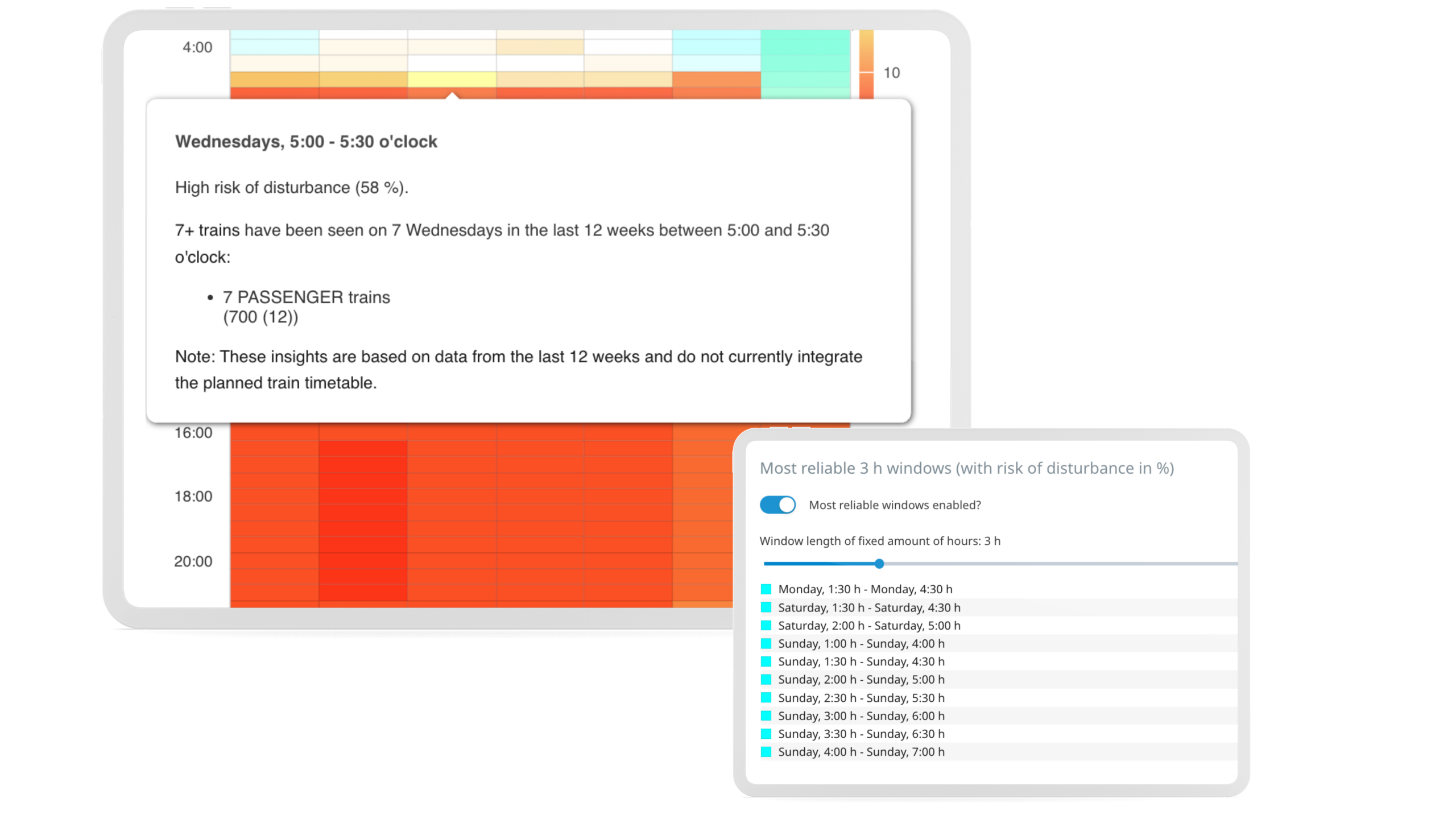
This simple but powerful view enables users to quickly spot low-risk access windows, validate planned work against real traffic patterns, and understand capacity implications before work starts. Feedback from early users shows that increasing granularity (from hourly to 15–30 minute slots) will further enhance precision – especially for short inspections or minor interventions.
Better Work, Less Disruption
By leveraging real traffic data, this feature helps infrastructure managers and asset owners achieve tangible outcomes:
- Higher quality maintenance: Less time pressure and fewer interruptions allow teams to do the job properly.
- Reduced operational impact: Maintenance is planned where it has minimal effect on capacity and services.
- Lower risk of speed restrictions: Timely, compliant inspections and interventions reduce the need for reactive measures.
- More confident planning: Decisions are based on evidence, not assumptions.
In some networks, even micro-windows in traffic pauses can be used for minor activities – unlocking capacity that would otherwise remain unused.
From Insight to Recommendation
The current Track Access Windows view is only the beginning. It opens the door to a future where track access planning becomes increasingly intelligent:
- Bundling activities to fit real-world access patterns
- Visualising planned field work alongside traffic data
- Actively recommending optimal time slots
- Alerting users when traffic changes put planned work at risk
Over time, these capabilities can become a core part of long-term maintenance planning, helping railways move from reactive scheduling to proactive, optimised execution.
As rail networks continue to operate under increasing capacity pressure, the ability to plan maintenance intelligently becomes a decisive advantage. Track Access Windows help infrastructure managers move beyond static schedules and assumptions, enabling them to align maintenance needs with real traffic behaviour. By identifying the right time to work, not just any time, asset owners can protect capacity, improve maintenance quality, and ensure long-term network reliability, even as access to the track becomes ever more constrained.
Beyond Access: From Inspections to Execution
Over time, this access intelligence can form the basis for a more connected approach to maintenance planning. When realistic access windows can be considered alongside inspection obligations, asset owners gain a clearer view of what has already been inspected, what inspections are due, and how compliance with standards and rule books can be maintained with less operational pressure.
The same applies to execution. Maintenance depends on more than time alone. Workforce availability and on-track machinery are equally critical, particularly where access windows are short and highly contested. Linking access planning with workforce and machine allocation allows requirements, resources, and access conditions to be considered together, supporting smoother execution, more efficient use of specialised machinery, and higher productivity during possession windows.
Taken together, these adjacent use cases point beyond access planning as a standalone task. They show how understanding when time on track truly exists can support better decisions across inspection, planning, and execution, especially as networks continue to operate closer to their capacity limits.
Written by
Petra Pavlovic
Marketing and Communications Director
Lily Hashemi
Senior Product Manager